


Monitoring of breathing air quality,
Almost every user has breathed the taste of oil in their compressed air.
The increased concentration of pollutants is usually manifested by headaches during prolonged breathing activity and by dizziness or even unconsciousness at higher concentrations of pollutants.
Every year there are injuries and deaths from poisoning worldwide, especially in the diving industry.
CO2which is often wrongly described as non-toxic can cause the above-mentioned symptoms at higher concentrations.
Since 1919 until today, fire departments, divers and industry have been testing air quality with so-called test tubes, which leave a large scope for interpretation due to the color display and usually have a standard deviation of 10 - 15%. They are also subject to a strong ageing process.
To make matters worse, this is only ever a snapshot in time.
Just one minute later, the air quality may have changed for whatever reason and nobody notices.
In tests carried out years ago by a well-known German diving magazine, comparative measurements were made on 5 different filling systems with test tubes and digital measuring devices, which mostly showed large measurement differences. Particularly with regard to water content and CO2 the measured values showed alarmingly high differences that were often far above the limit values of DIN EN 12021:2014. Above all, these tests showed that the CO2 limit value from DIN EN 12021:2014 can no longer be met almost everywhere due to increasing air pollution.
Above all, however, these measurements clearly show that the test tube measurements are no longer up to date from today's perspective and that these test tubes can at best be used as indicators.
Only permanent online monitoring offers real protection against poor air quality and undesirable pollutants in the air. This is the only way to prevent gradual damage to health, injuries or even deaths caused by contaminants in the breathing air, and the filling personnel are thereby protected from considerable liability risks. In our guide you can read was DIN EN 12021 vom Betreiber verlangt.
Air quality certificates from manufacturers
Manufacturer air quality certificates are often presented in sales talks and tenders. Such certificates provide information on the air quality at the time of testing, but their informative value has limits.
The persons and officials responsible for public tenders and also the responsible operators are happy to include such certificates in the documents required in the tenders.
When assessing a certificate, it is important to know under which conditions it was issued.
IDE COMPRESSORS only issues such certificates with appropriate explanations. A certificate only shows the condition at the time of testing and does not replace continuous monitoring at the installation site.
What does such a certificate say, and what does it not?
These certificates are usually issued by the manufacturer under defined conditions.
The location where the tests for the certificates are carried out usually has favourable conditions, i.e. no CO, low CO2 values in the intake air, no other harmful gases in the air, new intake air filter, cleaned condensate separators (or new ones), fresh filter cartridges.
These certificates are a snapshot and many operators do not know that the filter cartridges, which should really be called dryer cartridges, actually only filter out moisture and oil bound in the moisture and filter out bad odors, e.g. from the oil, with the activated carbon contained in the cartridges.
Aspirated pollutants such as CO, CO2SO2, Ci2, H2S and other gases that may be present in the ambient air drawn in are not removed by the filter cartridges; these are simply passed through the filter tower into the cylinders to be filled.
This means that different conditions may prevail at each location where the machines are operated. The certificate therefore only applies to the conditions at the time of testing.
These certificates also say nothing about the degree of saturation of the cartridges.
The saturation period from 85% to 100% is usually around 45 minutes, depending on the compressor output. This means, for example, that the values were measured with test tubes this morning before filling began and the filling process starts. But just 45 minutes later, the cartridges can be saturated and contaminated air gets into the cylinders.
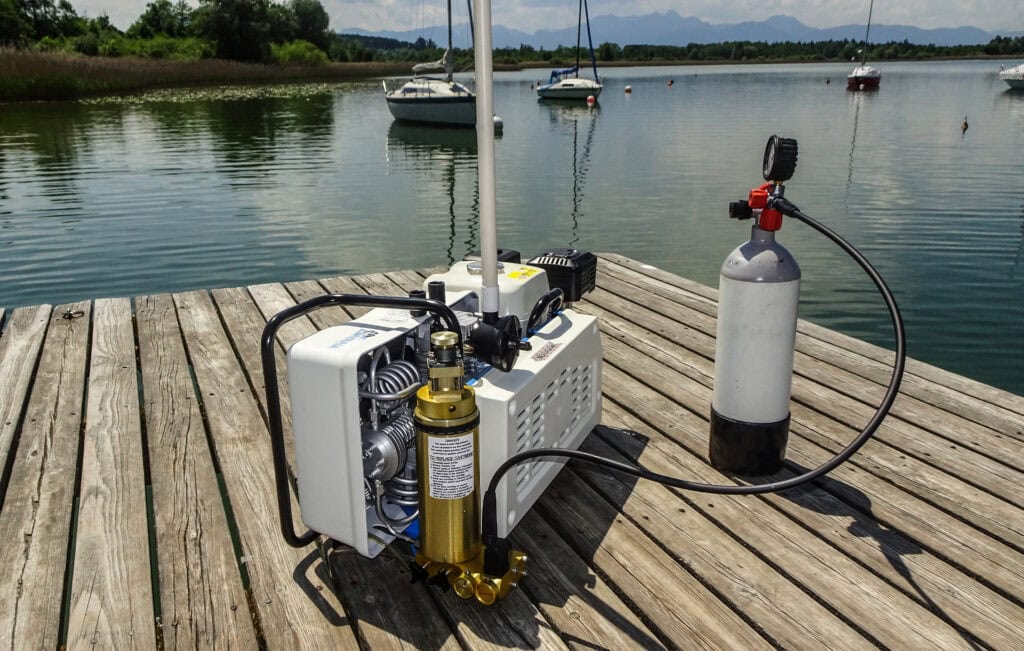
As early as 2007, IDE-Compressors was one of the first manufacturers to recognize the signs of the times and developed and launched the first online measuring device for AIRSAVE PREMIUM breathing air compressors. Over the years and to this day, IDE-COMPRESSORS has repeatedly defined the state of the art with its testing and measuring systems. The current product AIRSAVE ULTIMATE is the most advanced measuring device with measuring capabilities that go far beyond the breathing air standard.
More contributions:
Hydrotests und Druckbehälterprüfungen bis 1000 bar
Learn more to Hydrotests und Druckbehälterprüfungen bis 1000 bar
Atemluft-Füllanlage betreiben: Pflichten nach TRBS 3145 und TRGS 745, Grenzwerte nach DIN EN 12021
Learn more to Atemluft-Füllanlage betreiben: Pflichten nach TRBS 3145 und TRGS 745, Grenzwerte nach DIN EN 12021