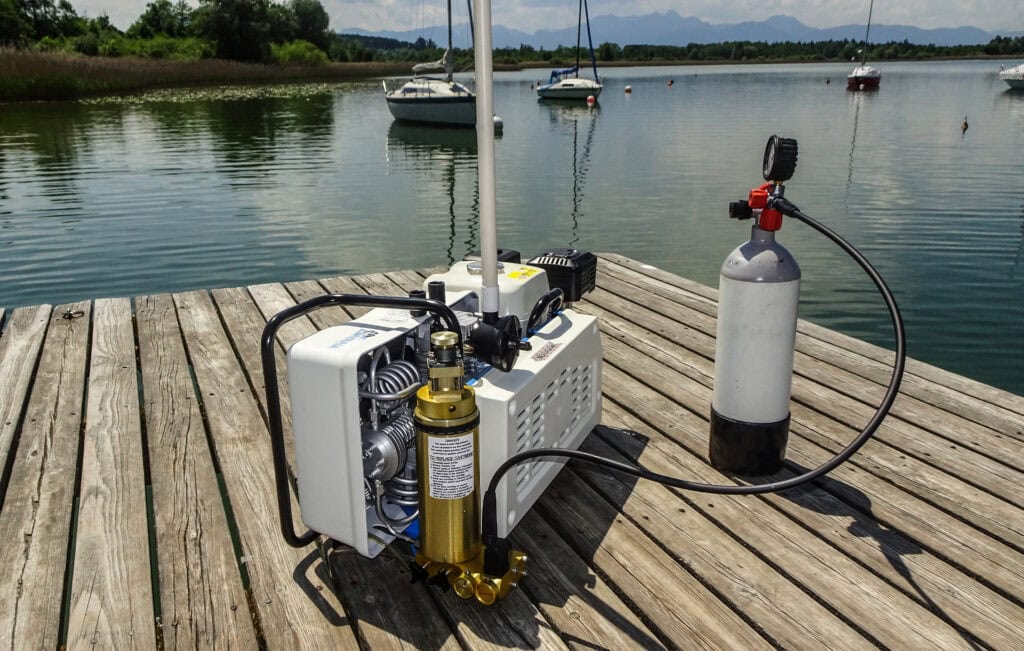



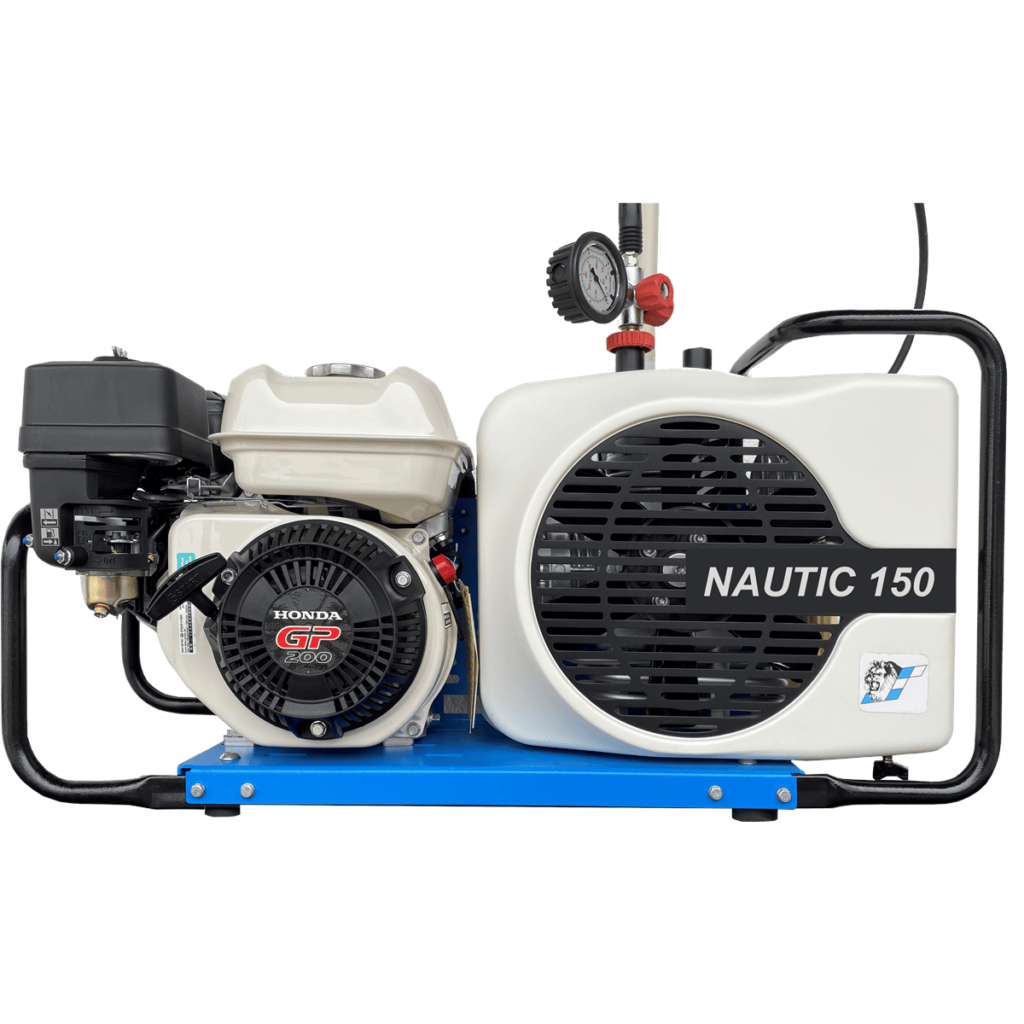
... is what divers buy themselves when they purchase a portable breathing air compressor. We tested the NAUTIC PRO 150 model from IDE.
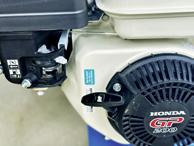
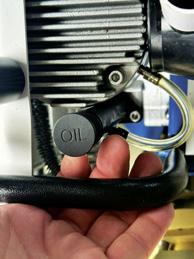
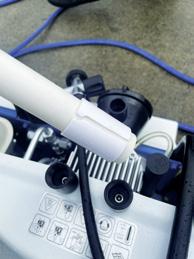
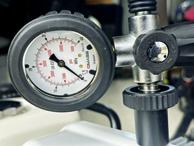
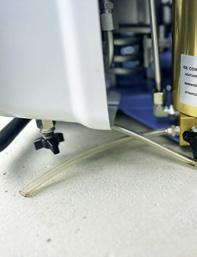
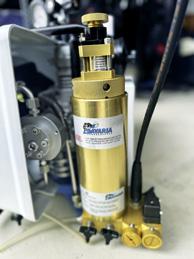
It’s always been my personal dream to be able to fill, empty, and refill my two »12s« whenever I want, regardless of the store hours at my dive shop or air compressor station. Just load all the gear into my van and head out—with the »gas station« for the tanks right in the back. I was finally able to make this dream come true. Unfortunately, though, it only lasted about two months, which meant twelve dives and twelve tank fills. First things first: Unfortunately, the compressor ended up back at the manufacturer after the test. Well, not quite. An acquaintance of mine runs an underwater construction company and ended up buying the test compressor. Why? Partly because he needed a new, portable unit. And because he, too, was able to test and use the »Nautic Pro 150« from IDE to fill his storage tanks for the helmet diving apparatus. But first things first. First impressions: The gasoline-powered version of the compressor arrived in a wooden shipping crate. For truly »fit« buyers, the crate—weighing just under 60 kilograms—is portable, though we don’t recommend it. Once unpacked, the »Nautic Pro 150« weighs 48 kilograms in our gasoline-powered version and up to 52 kilograms in the electric variants. Although strenuous, it’s still feasible to carry the unit from A to B on your own. Visually, the first impression regarding workmanship and material quality is good. Included in our shipment were: tools, the owner’s manual for the Honda gasoline engine and the compressor unit, a filter cartridge, the initial oil fill (including oil and an oil funnel for the first oil change), a DIN/INT adapter, the air intake tube, and, of course, the fill hose with a nozzle. In Use Before the first use, installing the filter cartridge (Type: VM 103 00 100H) is on the to-do list. The necessary tool is included in the package. According to the manufacturer, the filter cartridge should be replaced after 25 operating hours (at 20 degrees Celsius). Therefore, it makes sense to start keeping a small notebook for the compressor to record the fill times and quantities. Alternatively, a digital operating and filter monitoring system is available for retrofitting at a cost of 355 euros. I quickly checked the oil level. The manufacturer recommends the first oil change after 50 operating hours and then every two years. Of course, our model still needed gasoline (three liters). For the Honda engine (GP200) with 5.58 PS, a separate operating-hour counter with a tachometer is available as an option (approximately 150 euros). Finally, attach the extension tube for the intake filter. Once all preparations are complete, it’s time for the first fill. To do this, the filling valve is mounted on the cylinder. Depending on the compressor version, you can choose between the 200-bar or 300-bar filling valve. It’s also possible to install a second filling hose. We connect our 12-liter, 200-bar cylinder to the valve and open the cylinder. Set the gasoline engine to »ON,« set the speed control to full power, open the fuel valve, and pull the pull cord. And there it is! It works. The compressor and gasoline engine chug away—not exactly quietly (95 dB according to the manufacturer). Anyone who, like me, is thinking about quickly filling their tanks on a Sunday for a Sunday dive should either do it at the dive site or hope the neighbors are tolerant of noise. We timed the filling process. And, oh wonder, the manufacturer lied! According to our measurements, the Nautic Pro 150 actually delivers 152 liters per minute. That’s a whopping 8.6 percent more (!). Prerequisite: Set the machine to a starting pressure of 200 bar and then open the tank valve. Once the maximum pressure is reached—in our case, 225 bar—an automatic system shuts down the entire unit. The tank is closed, and the fill valve on the pressure gauge is vented. Then, all condensate drains on the filter are opened. A note on the filter housing states that the condensate valve must be opened every 15 minutes—which means, in practice, after every complete cylinder fill. Caution: Condensate will spray out. If you forget to vent the system, the unit will make its presence known the next time you try to start it—it won’t turn on. Caution is again advised, as the operating temperature reached has heated some components to the point where they cannot be touched. Feedback and Improvements »You quickly become blind to the obvious,« according to the manufacturer’s comment on a few minor issues we noticed in practice. One of these was the aforementioned »heat« issue. We noticed this the moment we tried to put the device away again shortly after use. The reason for the unpleasant contact: Our version of the device still had carrying handles that were mounted too close to the functional units. The new models no longer have this shortcoming. Here, the spacing between the brackets and the housing has been increased so that you can easily and confidently handle the unit—even in areas that aren’t as »hot«—and transport it. Also, when bleeding the second stage, the valve was inconveniently mounted facing downward. This has been changed. Now there’s just one remaining issue, which is somewhat more difficult to resolve and which, to our knowledge, other portable compressors also list as a shortcoming: The attachable intake hose is somewhat fragile due to the material it’s made of (plastic), and neither the filter nor the hose has any protection against rain. In our case, the compressor was used specifically for underwater work, even in bad weather. Water ran into the hose and caused the air filter to get wet. But that was really the only »minor negative« we noticed after our test run. All things considered, we come to the second most important point: the price. At 3,450 euros (plus VAT) for our gasoline version, it falls within a »reasonable range« and, given the 140-liter air delivery capacity and the five-year full warranty, is likely to rank highly in terms of value for money in a direct market comparison. But is such a purchase worth it for a “private individual”? Let’s do a quick calculation. Today, filling a cylinder at a shop costs between 50 and 70 cents per liter of cylinder volume (200 bar fill). So, at 60 cents per liter for a 12-liter tank, the average cost comes to at least 7 euros, but can easily reach 9 to 12 euros. For our gasoline-powered model, the following costs are added to the pure equipment costs: Filter cartridge (30 euros/25 hours, which equals 2 cents per minute of operation times a maximum of 15 minutes per bottle fill) 30 cents; fuel consumption (0.03 liters per minute times 2 euros per liter times a maximum of 15 minutes of fill time per bottle) 90 cents. If we disregard oil consumption, we arrive at pure operating costs of 1.20 euros per tank fill. So if we set a high estimate and calculate 9 euros per tank fill, the pure purchase price pays for itself after 460 fills (excluding ancillary costs per fill). If we divide that by two based on the buddy system, a buddy team of year-round divers reaches the point where the tank fill costs only the ancillary expenses (plus five filter changes) after 230 joint dives. If you want to look at the bright side. It can all be done for a few euros less: If you switch to the 140-liter electric motor version, the unit costs only 3,190 euros, further reducing both operating and ancillary costs. Conclusion: In our view, a mobile compressor is the epitome of diving freedom in any case. Ready for use anytime, anywhere (gasoline version), easy to transport, and powerful enough to refill your breathing gas supply during surface intervals—with a unit like this, the dream of independence comes a step closer to reality. In this case, the Nautic Pro 150 did not disappoint. Kudos to the manufacturer, who took our minor criticisms seriously and addressed them right away. From now on, the test model will be in use among professional divers.
Review by Alexander Kassler, Editor-in-Chief of „Tauchen“ magazine, issue no.: 3/24.
More contributions:
Hydrotests und Druckbehälterprüfungen bis 1000 bar
Learn more to Hydrotests und Druckbehälterprüfungen bis 1000 bar
Atemluft-Füllanlage betreiben: Pflichten nach TRBS 3145 und TRGS 745, Grenzwerte nach DIN EN 12021
Learn more to Atemluft-Füllanlage betreiben: Pflichten nach TRBS 3145 und TRGS 745, Grenzwerte nach DIN EN 12021