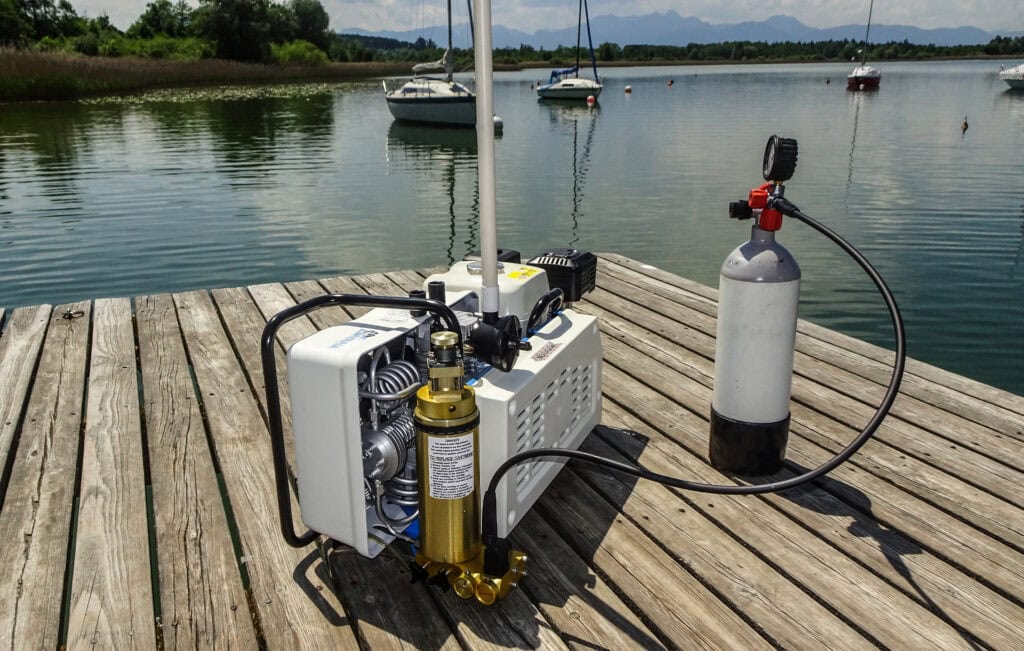




Air quality certificates from manufacturers are often presented in tenders and sales talks.
These are often certificates for DIN EN 12021:2014 that the manufacturer has drawn up itself.
DIN EN 12021:2014 is a European standard that clearly specifies how the breathing air must be composed and what concentration of pollutants may be contained in the breathing air. Such a certificate can give the user the impression that their compressor always supplies pure breathing air that complies with the standard.
The small print refers to possible air pollution in the intake area and to the installation instructions of the manufacturer.
However, the certificate can only reflect the conditions at the time of testing, because the compressor only compresses the air that it draws in.
If the compressor is located near a large parking lot, a busy road, in poorly ventilated small rooms, etc., it can suck in too much CO or CO2 and pump this harmful gas into the breathing apparatus.
A certificate cannot reflect the local conditions at the later installation site.
Many users believe that the downstream filter system of the compressor filters out these pollutants, but this is not the case. The term "FILTER", which has been used for decades, is not quite accurate. It is actually a drying unit. The so-called filter cartridge is filled with MOLECULAR FILTER and a little activated carbon. The molecular sieve only filters out the residual moisture contained in the compressed air, and the small amount of activated carbon filters out the oil odor contained in the moisture.
The dryer unit does not filter CO or CO2 from the compressed air in any way. The standard applies less to the manufacturer and more to the operator, who must ensure that the air pumped into the cylinders complies with DIN EN 12021:2014 at all times.
Many users are not aware of this, but in the event of an accident the filling personnel may be held responsible. For this reason, systems with ONLINE air quality monitoring are often used in the public sector; it can help to detect deviations early and to reduce the risk for the filling personnel.
More contributions:
Hydrotests und Druckbehälterprüfungen bis 1000 bar
Learn more to Hydrotests und Druckbehälterprüfungen bis 1000 bar
Atemluft-Füllanlage betreiben: Pflichten nach TRBS 3145 und TRGS 745, Grenzwerte nach DIN EN 12021
Learn more to Atemluft-Füllanlage betreiben: Pflichten nach TRBS 3145 und TRGS 745, Grenzwerte nach DIN EN 12021